
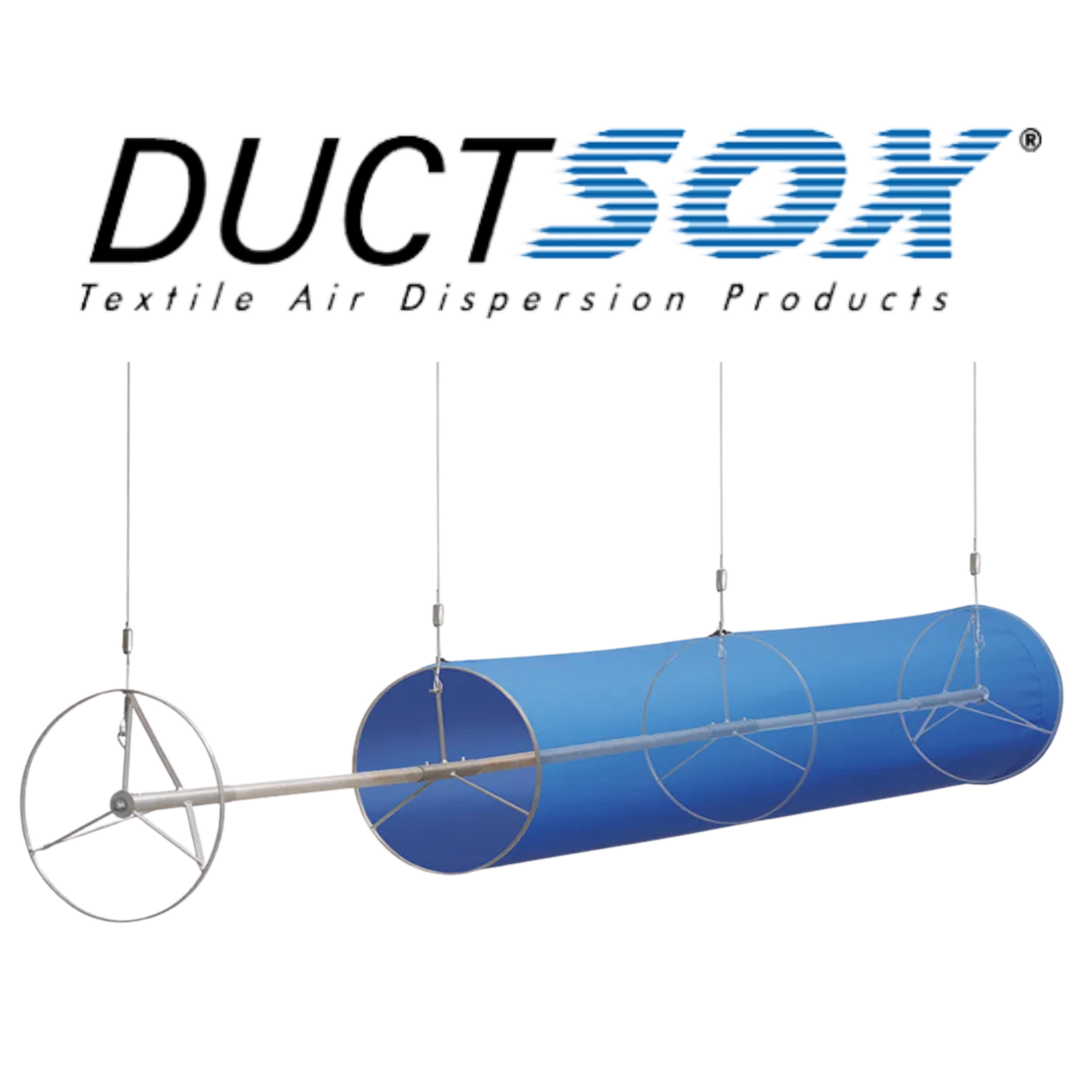
DuctSox Fabric Duct Systems offer an attractive, lightweight, and cost-effective alternative to conventional metal ductwork. They distribute and diffuse air efficiently. As a result, they are ideal for heating, cooling, make-up air, and refrigeration applications.
Air Diffusion is the authorised DuctSox distributor for South Australia. For sales and support in other Australian states, please contact ecoHVAC.
Constructed from high-quality fabric, DuctSox systems form cylindrical tubes similar in appearance to spiral metal ductwork. They provide a streamlined and attractive solution. They also deliver excellent performance and simple installation.
Features, Advantages, and Benefits:
- Simplified Design: Provides uniform air dispersion.
- Cost Savings: Costs 20 to 80% less than comparable metal duct systems.
- Lightweight: Makes transport and handling easier.
- Quiet Operation: Fabric helps absorb noise within occupied spaces.
- Air Porous: Helps eliminate the risk of condensation.
- Hygienic: Fabric includes an active antimicrobial treatment.
- Easy to Maintain: Remove and launder the system when required.
- Durable: Fabric will not dent like metal ductwork.
- Customisable: Available in a range of standard colours, patterns, and custom colours.
- Environmentally Friendly: Recycled fabric options. Improved indoor air quality. Conserves resources. Can reduce construction costs.

Fabric Ductwork vs. Metal Ductwork
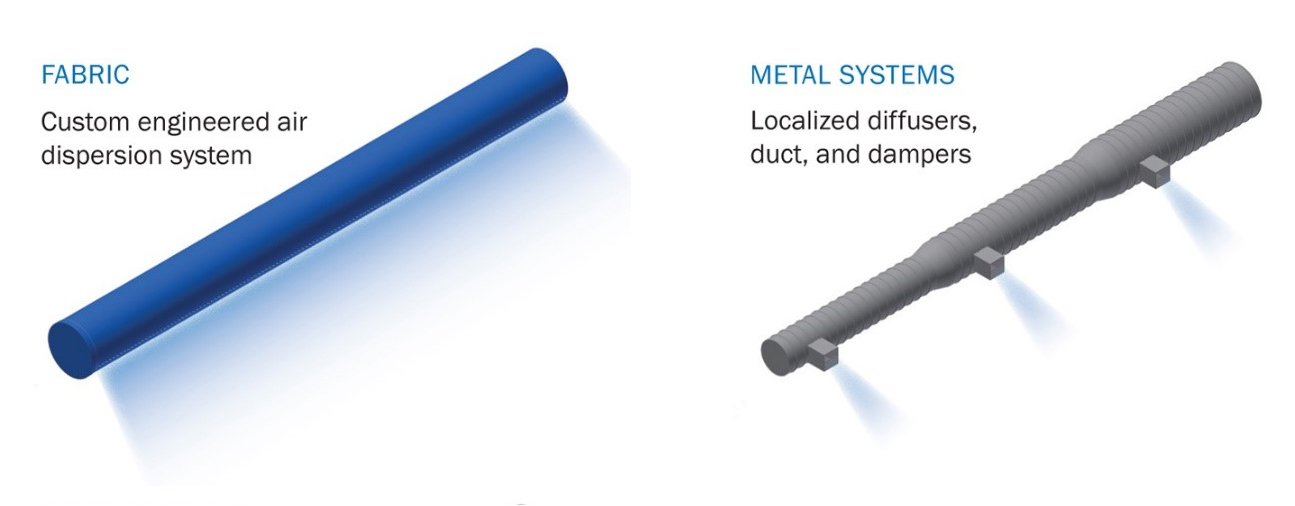
In open ceiling architecture, traditional metal duct systems discharge air through side-mounted metal diffusers. These diffusers are typically spaced 3 to 4.5 metres apart. Air is directed to specific zones. As a result, the occupied space experiences less efficient air mixing. This can also create drafts, hot spots, and cold spots.
In contrast, a DuctSox System discharges air evenly along the entire length of the duct. This provides consistent air distribution throughout the occupied space. Better air distribution creates better air mixing. Higher entrainment ratios also deliver consistent throw performance for orifices and linear vents. Conventional systems with high-volume diffusers often perform differently between heating and cooling modes because of buoyancy and airflow changes.
Fabric Duct vs. Sheet Metal Duct Study
Fabric duct is also 24.5% more efficient than conventional sheet metal duct and diffuser systems, according to a computational fluid dynamics (CFD) energy study conducted by the Iowa State University Mechanical Engineering Department in Ames, Iowa. The 10-month study, “Thermal Comparison Between Ceiling Diffusers and Fabric Ductwork Diffusers for Green Buildings,” compared the performance of fabric duct and traditional ceiling diffuser systems.
The study found that fabric diffuser systems heat rooms faster. They also distribute air more evenly. As a result, rooms reach the desired temperature sooner. Mechanical equipment therefore runs for less time. This helps reduce energy consumption.